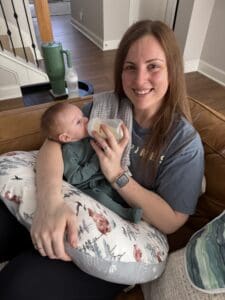
As a Speech-Language Pathologist with over ten years in the field, I have had countless experiences seeing oral ties firsthand. I have learned how oral ties can potentially lead to a variety of issues down the road, including but not limited to: difficulty with milk transfer during breastfeeding, difficulty taking bottles or transitioning to solids, impacts on palatal/jaw development, impacts on speech development, potential airway issues, difficulty maintaining proper tongue posture for nasal breathing, and full body tension. But even with all that said, nothing quite prepared me for the experience of my own son being diagnosed with oral ties as a young infant.
What are oral ties?
Oral ties typically occur when excess tissue tethers the oral tissues and restricts movement of these structures. Types of oral ties include: tongue ties (where the tongue is connected tightly to the floor of the mouth, either anteriorly (at the front) or posteriorly (in the middle)), lip ties (where either the top or bottom lip is connected tightly to the gums), and buccal ties (where the gums are connected tightly to the cheeks). Many times, you will see these ties occur concurrently in infants and children.
My Son’s Early Days:
When my son was born, one of the first things I did was open his mouth to visually look and see if any ties were present. I was relieved to see that I did not see an anterior tongue tie (which is much easier to identify than a posterior tongue tie), but was concerned that there might be a lip tie. Since he was born at 37 weeks and was quite small, he frequently fell asleep anytime he was at the breast or bottle– but as a first time mom, it was difficult to navigate what was a result of him being born slightly premature, and what might be a result of possible ties. When the hospital’s lactation consultant visited the following day, I immediately shared my concerns of a lip tie, and after looking herself, she quickly brushed it off and said that there were no ties and to keep doing what we were doing (offering the breast frequently, pumping, and supplementing with formula when needed). Days later, I left the hospital feeling nervous but optimistic that with a little bit more time and growth, he would be able to breastfeed exclusively. Unfortunately, just a little over 24 hours from the time we got home, I was rushed back to the hospital’s ER with a variety of symptoms— shortness of breath/wheezing, elevated pulse/blood pressure, and coughing up blood. After significant testing, I was diagnosed with postpartum pre-eclampsia and a pulmonary edema. Due to the dire nature of my diagnosis, I was hospitalized for multiple days away from my sweet baby boy.
After my discharge and continued difficulties with breastfeeding at home, I decided to speak with a family friend who is a retired lactation consultant. In those early days, she helped me with establishing my supply, to hopefully be able to make enough to exclusively breastfeed. As I began breastfeeding again, my son seemingly had a good latch, but I quickly noticed that he would take 40-50 minutes to breastfeed and would frequently still not be satisfied after feeding. He took bottles fairly well, but often made a clicking sound and lost milk out of the sides of his mouth. I also began noticing that he had a definite side preference for his left side, as well as overall body tightness. At our one month pediatrician appointment, we also found out that his weight gain was extremely slow for his age. After this appointment, I knew in my gut that I needed to start digging deeper, because I felt that there was something that we were missing.
Next Steps:
I then called on the help of close friends in the field, because I was suspicious that he was not transferring milk appropriately. Over the next couple of weeks, we saw feeding therapists at PediaSpeech (thanks Allison, Sydney, and Jennifer!), an IBCLC, and an occupational therapist, who all helped us to identify a milk transfer issue (confirmation through weighted feeds), high palate, lingual incoordination, oral ties, and body tension leading to his left side preference. We were then referred to a pediatric dentist, who completed a full functional oral assessment and confirmed our suspicions. My son had a posterior tongue tie, lip tie, and two buccal ties, which were all leading to the issues we had been seeing at home. After his diagnosis, I breathed a sigh of relief. I knew in my gut that there was something more to what I was seeing, but when it’s your own child and you’re in the thick of postpartum, it sometimes makes it even more difficult to clearly see the bigger picture. We immediately had his oral ties released, with a strict follow-up plan of after care procedures, oral stretches every four hours, and appointments with all of our providers, in order to continue working through his body tension, incoordination with feeding, and my supply issues. We almost immediately saw breakthroughs, with my son transferring 3oz during breastfeeds, feeds taking significantly less time, body tension releasing, clicking subsiding during bottle feeds, and my supply increasing!
Final Thoughts:
I will forever be grateful to my coworkers at PediaSpeech, friends, and other providers for listening to my concerns and helping us to navigate my son’s oral tie journey. But at the same time, I am acutely aware that my previous knowledge as a Speech-Language Pathologist and my personal connections with providers was a privileged experience overall. That is the reason I am here today writing this blog– I want others who may not have the previous knowledge to hear some of the early signs of oral ties, so that you can confidently advocate for your children in the way I was able to. Oral ties can often be overlooked by hospital lactation departments, as well as pediatricians– so please call on the help of your local Speech-Language Pathologists, Occupational Therapists, IBCLCs, and Pediatric Dentists if you have any concerns at all. Their expertise and compassion can help you on your journey, as they did with mine!