

Occupational Therapy
Pediatric Occupational Therapy in Atlanta
Helping children build the skills they need for everyday success
Children learn about their world through movement and play. At PediaSpeech we help children develop the physical, sensory, cognitive, and self-care skills needed to succeed at home, in school, and within their communities. Whether your child experiences sensory processing challenges, fine motor delays, handwriting difficulties, or struggles with everyday tasks, our experienced occupational therapists create personalized treatment plans designed to support long-term growth and success.
We offer both in-person and telehealth Occupational Therapy (OT), depending on your child’s needs.
What is Occupational Therapy?
Through occupational therapy, we provide the opportunity to develop the strength, body awareness, balance, and perceptual abilities necessary to acquire gross and fine motor skills in order to make interacting with the environment a successful experience for your child.
A variety of sensory and movement experiences are provided at our Atlanta location to introduce the child to activities and interactions aimed at developing specific areas based on the child’s needs. The approach taken at PediaSpeech is family oriented and parents are exposed to methods that can be taken home and incorporated into the daily routine with the goal of generalizing the child’s learned skills across contexts.
Does your child need occupational therapy?
A referral for an occupational therapy evaluation may be necessary if your child has difficulties in several of the areas listed below or major functional problems in one area.
- Unusually fussy, easily startled, or difficult to console as an infant
- Slow to achieve motor milestones, such as rolling over, creeping, sitting, standing, or walking
- Strongly dislikes and protests baths, hair washing, haircutting, or nail cutting
- Uses inappropriate amounts of force when handling objects, coloring, writing, or interacting with friends, sibling, or animals
- Leans on people, slumps when sitting, tires/fatigues easily, has poor muscle tone
- Proprioception, falls frequently, bumps into furniture or people, is clumsy, or has difficulty judging position of his/her body in relation to space
Signs Your Child May Benefit from Occupational Therapy:

Physical Disabilities
Physical disabilities encompass a wide range of conditions that may affect a child's movement, coordination, strength, endurance, or ability to participate independently in everyday activities. These disabilities may be congenital, meaning they are present at birth, or acquired as a result of illness, injury, or other circumstances. Depending on the individual child, a physical disability may impact their ability to reach developmental milestones, participate in play and school activities, complete self-care tasks, or engage in daily routines as independently as possible. At PediaSpeech, our occupational therapists work with children and families to identify individual strengths, address functional challenges, and develop practical strategies that support greater participation and independence.

Fine Motor Difficulties
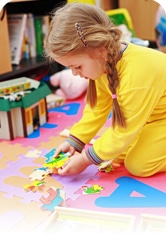
Fine motor difficulties refer to challenges with using the small muscles of the hands, fingers, and wrists to perform precise, coordinated movements. Fine motor control is often thought of due to its essential role in participating in school-based activities such as writing, cutting, coloring, and manipulating any small objects. Fine motor area of development is also needed for independence in dressing, feeding, hygiene, play, and almost any facet of life one is engaged. Children require the development of fine motor skills to grasp and voluntarily release any object and complete tasks efficiently and effectively. Occupational therapy can affect change in this developmental area through strengthening, bilateral tasks, adaptive strategies, and parent education to help the child build confidence in what can be a very frustrating area of development.
Sensory Processing Disorders (SPD)
Sensory Processing (sometimes called "Sensory Integration") refers to the way the nervous system receives messages from the senses and turns them into appropriate motor and behavioral responses. A child with SPD finds it difficult to process and act upon information received through the senses. Often times the sensory stimuli received is perceived as too high intensity (hypersensitivity / hyper-responsive) or not perceived at all (hyposensitivity / hypo-responsive). Sensory integration issues can create everyday problems such as: poor motor planning, decreased body awareness, behavioral problems, anxiety, low self-esteem, poor understanding of one’s environment, and distress caused by being generally overwhelmed.
Suggested activities & Helpful sites
Fun Activities for parents and children at home
Movement Play
Obstacle courses, Simon Says, follow the leader, bike riding, swimming, jumping into / on cushions, exercise ball activities...
Tactile Play
Sand, water, leaves, shaving / whipped cream, shampoo, rice, etc.
Arts and crafts activities
Promote fun fine motor play through arts and crafts activities.
Clay or Play-doh
Helps children explore their creative side and improved fine motor strength, using both hands together, and isolating finger movements.
suggested websites
Pediastaff
One of the best sites broken into categories for finding great play and therapy ideas.
Crayola
Arts and crafts and free coloring pages to work on those fine motor skills.
Discount School Supply
Full of educational material and toys specific to developmental skills.
Pocket Full of Therapy
Full of educational material and toys specific to developmental skills.
Resources
The STNR Reflex – A Simple Guide for Parents and How to Support It at Home
Help Your Child Build Skills for Life
Schedule an OT evaluation
From fine motor skills and sensory processing to self-care, coordination, and everyday activities, our pediatric occupational therapists help children develop the skills they need to participate more confidently at home, at school, and in their communities. Let’s take the first step toward helping your child thrive.